

Learning English can feel overwhelming when you are not sure where to begin. You may know some words but struggle to put them together. You may understand a lesson when you read it, then find it difficult to follow a conversation. With so many courses, videos, and apps available, choosing what to study can become a task of its own.
A practical way forward is to connect learning with use. Listen to and read English you can understand, notice useful words and patterns, and practice expressing your own ideas. Get feedback when possible, then return to what you have learned until you can use it more independently.
You do not need perfect grammar or a large vocabulary to begin. You need a manageable routine, a clear purpose, and opportunities to communicate. This guide will help you build that approach, with sample activities, daily schedules, and a plan for your first 30 days.
Start With Your English Level and Your Goals
The right learning plan starts with two questions: What can you already do in English, and what would you like to do next?
Your answers will help you choose suitable materials and avoid spending too much time on topics you do not currently need.
Check What You Can Already Do
Your listening, speaking, reading, and writing skills may develop at different speeds. Being able to read an article does not necessarily mean you can discuss the same subject comfortably.
Try these simple tasks to get a clearer picture:
| Skill | Starting task | Questions to ask yourself |
|---|---|---|
| Listening | Listen to a short beginner conversation. | Can I identify the topic? Can I understand important details? |
| Speaking | Record a short introduction about yourself. | Can I explain basic information without reading every sentence? |
| Reading | Read a short text about a familiar subject. | Can I understand the main idea without translating everything? |
| Writing | Write five sentences about your day. | Can I express my meaning clearly? Where do I get stuck? |
Keep your recording and writing sample. They will give you something concrete to compare with later.
These tasks are an informal starting point. If you are choosing a course or preparing for an examination, a placement test or teacher assessment can provide more detailed guidance.
Choose a Goal You Can Practice
“I want to become fluent” is a reasonable ambition, but it does not tell you what to do during your next study session.
A practical goal describes something you want to accomplish:
- Introduce yourself and ask someone about their interests.
- Order a meal and explain a preference.
- Make an appointment and confirm the details.
- Describe your work responsibilities.
- Write a short message requesting information.
For example:
“By the end of this month, I want to introduce myself, describe my daily routine, and answer simple questions about both.”
You now have a reason to learn particular words and sentence patterns. You also have a task you can repeat to check your progress.
Start with one main goal. You can add new goals as familiar tasks become easier.
What Should You Learn First in English?
Beginners need useful vocabulary, basic sentence patterns, and practice understanding how English sounds. These areas work best together.
Instead of memorizing a word on its own, learn it in a sentence. Instead of reading a grammar rule repeatedly, use the pattern to say something about your life.
Begin With Useful Words and Everyday Phrases
The following 20 words form a small starting set. They are examples of useful language, rather than a complete vocabulary list or a ranking of the most common English words.
| Word | Example |
|---|---|
| I | I live near here. |
| you | Do you speak English? |
| we | We study together. |
| be | I want to be a teacher. |
| have | I have a question. |
| do | What do you do? |
| go | I go to work by bus. |
| want | I want some water. |
| need | I need help. |
| like | I like this book. |
| know | I don’t know the answer. |
| understand | I understand the question. |
| help | Can you help me? |
| time | What time does it start? |
| day | Have a good day. |
| work | I work from home. |
| home | I’m going home. |
| what | What does this mean? |
| where | Where is the station? |
| how | How do you say this? |
Some words change form depending on how they are used. For example, be appears as am, is, or are in sentences such as “I am ready” and “They are ready.” You will learn these forms through explanation, examples, and repeated use.
Choose a few expressions and make them personal:
I need help with this form.
I work in a restaurant.
I want to practice speaking.
Also learn phrases that help you manage a conversation:
Could you say that again, please?
What does that word mean?
Could you speak a little more slowly?
These expressions let you continue communicating when you do not understand everything.
Build Sentences With Basic Grammar
Grammar gives you patterns for making your meaning clear. Begin with structures that support your goals.
| Purpose | Example |
|---|---|
| Give information | I work at a school. |
| Describe someone or something | My neighborhood is quiet. |
| Make a negative statement | I don’t drive. |
| Ask a question | Do you work nearby? |
| Describe a completed event | I visited my friend yesterday. |
| Explain a plan | I’m going to study tonight. |
Practice changing one part at a time:
I work at a school.
My sister works at a school.
My sister doesn’t work at a school.
Does your sister work at a school?
Notice what changes and what stays the same. Then create examples about people and situations you know.
You do not need to learn every tense before speaking. Study a manageable pattern, use it, and return to it when you need to express something more precisely.
Connect Pronunciation With Meaning
Pronunciation practice should help you understand others and make yourself understood. You do not need to remove every feature of your accent.
Start with short, useful phrases. Listen for individual sounds, stressed words, and the way the speaker groups words together.
Try this process:
- Listen to a phrase and check its meaning.
- Listen again, paying attention to how it sounds.
- Pause and repeat it.
- Record your version.
- Compare one feature, such as word stress or a missing ending.
Focus on a small section rather than copying an entire video. After practicing the phrase, use it to communicate something of your own.
Make English Practice Part of Your Day
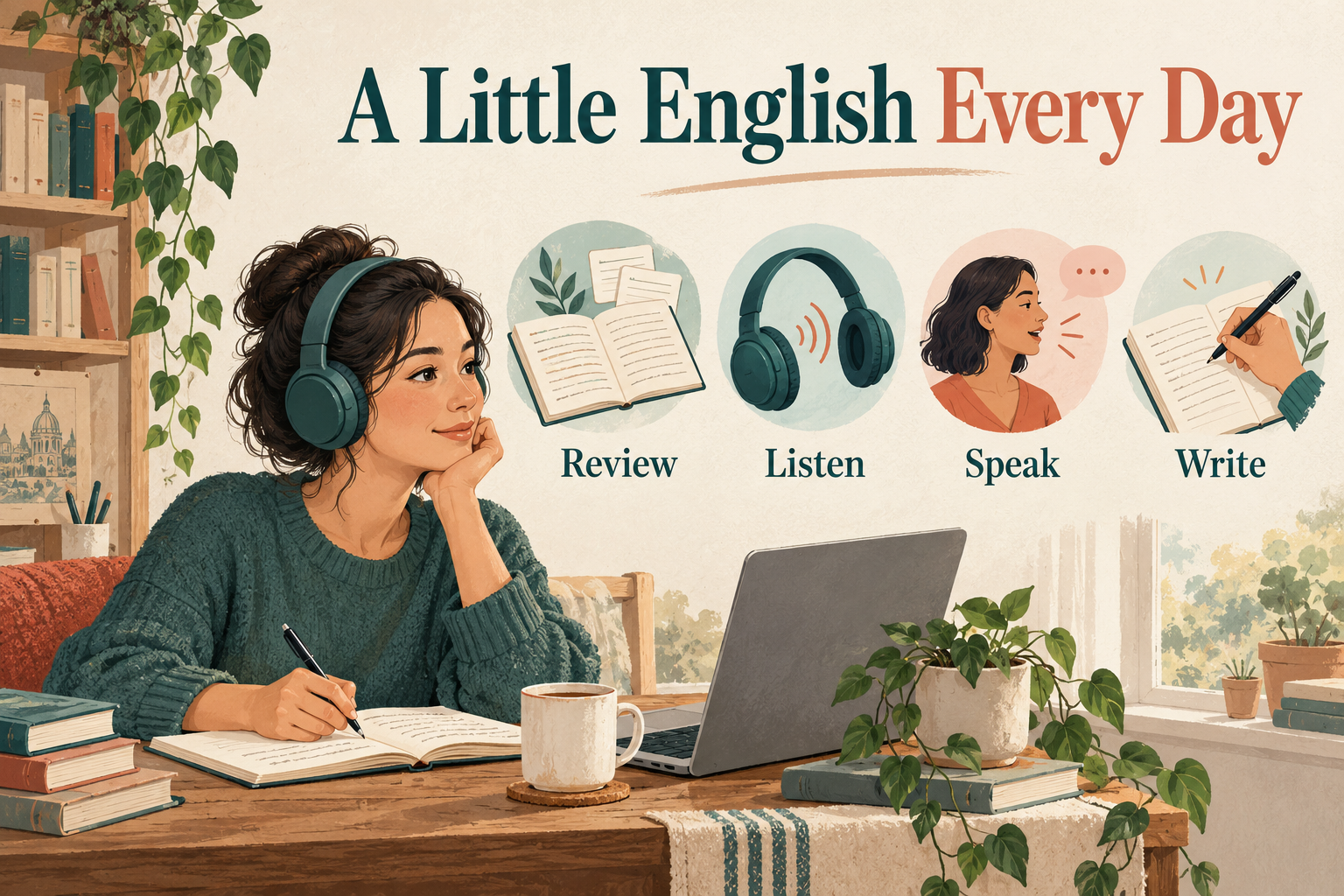
A useful routine reduces the number of decisions you need to make before studying. You should know what material to open, what activity to do, and what you want to produce.
The schedules below combine review, listening or reading, active use, and a brief check. Adjust them to your energy, goals, and available time.
A 15-Minute Routine for Busy Days
| Time | Activity | What to do |
|---|---|---|
| 3 minutes | Review | Recall three familiar phrases, then check your answers. |
| 4 minutes | Listen and read | Work with one short conversation or paragraph. |
| 4 minutes | Speak | Repeat useful language and make your own examples. |
| 3 minutes | Respond or write | Answer a few questions or write two related sentences. |
| 1 minute | Check | Note one correction or question for next time. |
Keep the activities connected. If you listen to a conversation about weekend plans, use your speaking and writing time to describe your own plans.
You do not need to choose a new topic every day. Returning to the same material can help you understand more and use it with less support.
A 30-Minute Routine for More Practice
| Time | Activity | Expected result |
|---|---|---|
| 5 minutes | Review previous learning | Recall and use familiar words and phrases. |
| 8 minutes | Listen and read actively | Understand the main message and important details. |
| 7 minutes | Repeat and adapt | Create sentences that fit your situation. |
| 7 minutes | Speak or write independently | Produce a short recording, conversation, or text. |
| 3 minutes | Check and plan | Identify one improvement and one next step. |
Leave enough time to use English without copying. Watching explanations and highlighting vocabulary can support learning, but they should lead to an attempt to communicate.
The time divisions are suggestions, not rules. If speaking is your main difficulty, give it more attention while continuing to develop the skills that support it.
Choose Materials You Can Work With
Begin with a small collection of resources:
- A structured beginner course or textbook.
- Short audio recordings with transcripts.
- A learner’s dictionary with pronunciation examples.
- A notebook or review tool.
- A way to practice speaking and receive feedback.
Choose material that gives you something to learn without making every sentence a struggle. You should be able to follow the main message with reasonable support.
If you stop constantly, try a shorter or easier text. If the material feels very easy, make the task more demanding: summarize it without looking, answer an unexpected question, or explain it in a different way.
Put Your English Into Practice: A Café Conversation

A complete practice lesson connects understanding with communication. The example below shows how you can move from reading a model to using the language yourself.
Situation: Ordering a drink at a café.
Goal: Request a drink, answer simple questions, and ask the price.
Understand the Conversation
Read the dialogue below. For listening practice, use a spoken version from a teacher, speaking partner, or audio tool.
Assistant: Hi! What can I get for you?
Customer: Could I have a small coffee, please?
Assistant: Sure. Would you like milk?
Customer: Yes, a little milk, please.
Assistant: Is that for here or to go?
Customer: To go, please. How much is it?
Assistant: Three dollars.
Customer: Here you go. Thank you.
Check the main information:
- What does the customer order?
- Does the customer want milk?
- Will the customer stay at the café?
If you miss an answer, return to that part of the conversation. You do not need to understand every expression immediately to identify the main message.
Notice Useful Phrases
Focus on language you can reuse:
| Expression | Purpose | Another example |
|---|---|---|
| Could I have …, please? | Make a polite request | Could I have a tea, please? |
| A little …, please. | Request a small amount | A little sugar, please. |
| To go, please. | Ask to take your order away | A sandwich to go, please. |
| How much is it? | Ask the price of one item | How much is the sandwich? |
Say an expression, cover it, and try to recall it. Then change one detail.
For example, replace a small coffee with a medium tea. Once that feels comfortable, change the size, drink, and milk preference together.
Create Your Own Version
Hide the original dialogue and complete these tasks:
- Order a medium tea.
- Say you do not want milk.
- Say you want to stay at the café.
- Ask the price.
You can play both roles and record the conversation. If you have a partner, ask them to change the question order so you must listen before responding.
After speaking, write a short version of your order. This gives you another opportunity to work with the same language.
Use Feedback and Try Again
Imagine you say:
“I would like small coffee.”
Your meaning is understandable, but the sentence needs an article when referring to one cup:
“I would like a small coffee, please.”
Do more than read the correction. Use the pattern again:
I would like a small tea, please.
I would like a sandwich, please.
Then repeat the conversation without reading.
Teacher’s tip: Choose one or two useful corrections during a practice session and apply them immediately. Working through a small amount of feedback is often more manageable than trying to fix every detail at once.
How to Practice English at Home and With Others
Independent practice gives you time to prepare, repeat, and experiment. Conversation asks you to respond to someone else, including questions you did not expect.
Include both when you can. They serve different purposes and can support each other.
Record Yourself and Retell Short Stories
Choose a short text or recording that you mostly understand.
- Read or listen for the main idea.
- Write three to five keywords.
- Close the text.
- Explain the message in your own words.
- Record your explanation.
- Check whether you included the important points.
Retelling does not require you to memorize the original sentences. You are practicing how to organize and express meaning.
For a simpler activity, answer a familiar question:
What did you do this morning?
What are you going to do tomorrow?
What do you like about your neighborhood?
Start with a few sentences. Add details when you can express the basic message comfortably.
Bring English Into Everyday Activities
Choose activities that match your interests and level:
- Read a short recipe and explain the steps.
- Watch a brief video and describe one thing you learned.
- Write a shopping list, then say what you need.
- Read a simple article and summarize its main point.
Give each activity a purpose. Before watching a video, decide what you want to understand. Afterward, answer a question or explain an idea.
Background listening can provide exposure, but focused practice involves checking meaning and responding. Include some time when English has your full attention.
Make Conversation Practice More Useful
Before meeting a speaking partner, choose a topic and prepare a few questions. For a conversation about daily routines, you might ask:
What time do you start work?
How do you travel there?
What do you usually do in the evening?
Ask follow-up questions based on the answers. This helps you move beyond rehearsing separate sentences.
At the end, ask for one useful correction or clarification. Repeat the improved expression before finishing.
For language exchanges, agree on how to divide the time between languages. When working with a teacher, explain your communication goal so the activities and feedback address it.
Use AI for Extra Practice and Feedback
AI tools can provide role-play, sample conversations, and explanations. To make the practice useful, give the tool a clear task and produce your own language before asking for help.
Practice a Specific Situation
You can use a prompt like this:
Act as a café assistant. Use beginner-level English and ask one question at a time. Wait for my answer. After the conversation, explain two important mistakes in simple English. Then let me try again.
You can change the situation to introducing yourself, arranging a meeting, or asking for directions.
For writing practice, draft your message first. Then request feedback:
Check this short email. Identify two changes that would make it clearer. Explain the changes in simple English, then ask me to rewrite it.
This keeps you involved in the learning process. Reading a finished answer is useful for observing a model, but rewriting gives you a chance to apply what you noticed.
Adjust the Difficulty and Check Uncertain Advice
Tell the tool what you need:
Use shorter sentences.
Give me one example at a time.
Ask questions about my job.
Explain that correction without technical grammar terms.
AI feedback can be inaccurate or inconsistent. Check uncertain explanations with a reliable learning resource or teacher. Treat automated pronunciation scores and level estimates as practice feedback, rather than formal assessments.
Use AI to create additional opportunities to practice while continuing to seek real conversations where possible.
Your First 30 Days of Learning English
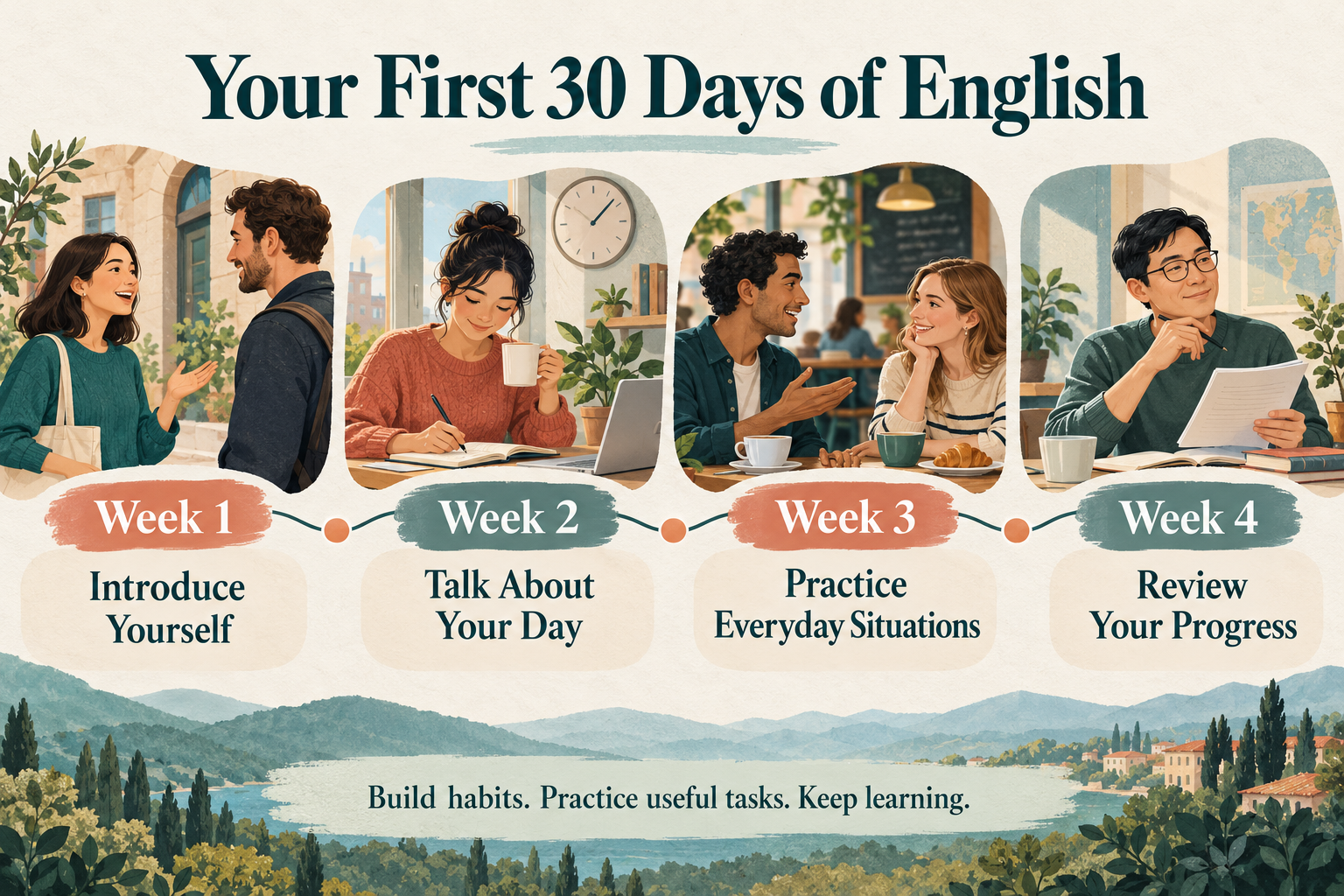
A month is a useful period for establishing a routine and working toward specific beginner tasks. It is not a guarantee of fluency.
Adapt this plan to your starting point. If you already handle one topic comfortably, choose a more relevant challenge.
Week 1: Introduce Yourself and Ask Simple Questions
Focus on your name, location, work or study, and interests.
Prepare a short introduction and questions you can ask another person. Practice answering in different orders so you do not depend entirely on a script.
End-of-week task: Introduce yourself and answer three simple questions without reading full sentences.
Week 2: Describe Your Daily Routine
Learn the language you need to describe everyday activities and times.
Practice statements, questions, and negative sentences:
I start work at nine.
What time do you start?
I don’t work on Sundays.
End-of-week task: Describe a typical day and respond to a few follow-up questions.
Week 3: Handle an Everyday Situation
Choose one scenario, such as shopping, ordering food, or making an appointment.
Practice requesting something, checking information, and asking for repetition. Change details between attempts so you must pay attention.
End-of-week task: Complete a short role-play that includes at least one unexpected question.
Week 4: Review and Choose Your Next Goal
Return to the words and tasks from earlier weeks. Spend extra time on expressions you still struggle to recall.
Repeat your first introduction and compare it with the original recording.
End-of-week task: Write down what you can do more comfortably, identify one continuing difficulty, and choose your next goal.
Build review into every week. If a task is still difficult, continue working on it rather than moving forward simply because the week has ended.
Recognize Your Progress and Work Through Difficulties
Progress is easier to notice when you compare familiar tasks over time. Your daily impressions may change with your confidence, energy, or the difficulty of the material.
Compare the Same Task Each Week
Use a short record:
| Question | What to note |
|---|---|
| Did I complete the task? | The information I successfully communicated. |
| Was my meaning clear? | Places where I needed to repeat or explain. |
| How much support did I need? | Whether I relied on a script, notes, or translation. |
| What should I practice next? | One recurring difficulty. |
Look for practical changes. Perhaps you answered with less preparation, remembered a phrase when you needed it, or understood a reply you previously missed.
This is a way to guide your practice, not an official proficiency assessment.
When You Remember Words but Cannot Use Them
Recognizing a word while reading is different from recalling it during a conversation.
Turn vocabulary into a task. Instead of rereading appointment, ask yourself:
How would I ask to make an appointment?
Answer without looking, check your response, and return to it in later sessions. Use the expression in different situations to make it more flexible.
When Pronunciation Makes Communication Difficult
Identify the specific problem. It might involve an unclear sound, a missing word ending, or stress that makes a word difficult to recognize.
Work on one short phrase and compare it with a spoken model. Ask for feedback where possible, then use the phrase in a meaningful exchange.
Avoid judging your entire accent from one difficult recording. Focus on changes that make your message clearer.
When You Understand More Than You Can Say
Reduce the size of the speaking task:
I like this neighborhood.
I like this neighborhood because it is quiet.
I like this neighborhood because it is quiet, and the shops are nearby.
Begin with something you can say and gradually add detail. Prepare useful language, then practice without reading it.
Give yourself time to respond. A short pause is a normal part of conversation.
When Your Routine Is Hard to Maintain
Create a minimum version for busy days: review two expressions, listen to a short dialogue, and say three sentences.
Connect practice to a predictable moment and prepare your materials beforehand. If you repeatedly miss sessions, adjust the plan to fit your actual schedule.
After missing a day, return to the next manageable session. You do not need to compensate with an exhausting study marathon.
Common Questions About Learning English
How Can I Learn English More Easily?
Choose suitable material, focus on a practical goal, and divide your practice into manageable tasks. Work thoroughly with a short conversation before adding more resources. A clear routine reduces confusion, although learning still takes effort and repeated practice.
Can I Learn English by Myself for Free?
You can develop many skills with free lessons, audio, reading materials, dictionaries, and exercises. Organize them into a sequence and include speaking and writing. Language exchanges and community groups may provide conversation opportunities, while teachers can offer more focused assessment and guidance.
Can I Learn English in 30 Days?
You can work toward specific beginner tasks and build a study habit in 30 days. You might become more comfortable introducing yourself or handling a practiced situation. Communicating independently across a wide range of topics requires continued learning.
How Long Does It Take to Become Fluent in English?
There is no single timeline. Everyday conversation, professional communication, and academic study involve different demands. Your starting level, practice time, goals, and opportunities to use English all affect your progress. Define the tasks you want to perform and review your ability to complete them.
What Is the Best App for Learning English?
Choose an app according to the skill you need to develop. Look for structured progression for foundational learning, audio with transcripts for listening, or meaningful interaction for speaking. Try a sample activity and consider whether it helps you use English independently. Completing exercises or maintaining a streak does not, by itself, show what you can communicate.
Choose one useful English task today. Find a short model, practice a few expressions, and record yourself completing it.
Keep that attempt. After several practice sessions, try again and compare what you can do. Let the improvement—and any remaining difficulty—guide your next step.
